High Income Crops for the Market Gardener (or Ambitious Backyard Grower)
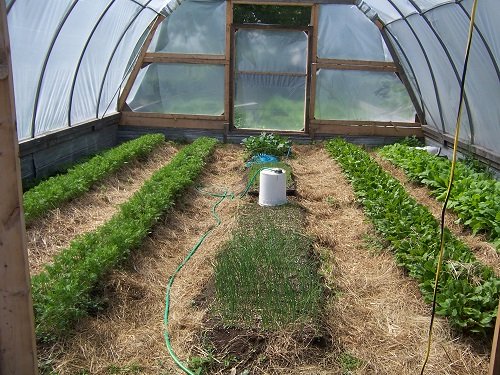 Carrots, beets, and bunching onions are one of my favorite high income crops if planted early and intensively Carrots, beets, and bunching onions are one of my favorite high income crops if planted early and intensivelyIf income matters, crop choice comes first. I’ve read a few articles about growing high income crops, and after a while I noticed some similarities:
1 - They all seem to converge on maybe a dozen choices e.g. ginger, grapes, lavender, even cotton;
2 – They don’t pay a lot of attention to other factors that may affect your crop choice. For example, I can’t really see a backyard cotton garden getting very far. The highest-priced crop is not always the most profitable crop. What matters is how much you can earn from each bed after accounting for labour, timing, local demand, and production risk. You need to understand those factors for everything you grow. For example, I make a nice profit with carrots, beets, and bunching onions because I have a system that lets me grow them intensively and a market that will pay me a premium in the early season. So with all that as foreword, here are some other high income crops that seem worth a spot on the list. Quick Answer: Which High-Income Crop Is Best?The best crop is not always the one with the highest selling price. We also need to consider labour, speed, local demand, and how much income the crop can produce from limited space.
Our practical pick: Garlic offers one of the best combinations of selling price, storage life, customer demand, and reasonable labour. Salad greens can generate faster cash flow, but they require a dependable production and sales system. Want the Complete Field-Tested List?This article gives you several strong candidates for your high income crop list. What if you had a field-tested list of the most profitable vegetables, based on real-world pricing and sales results? Grow the 10 Most Profitable Vegetables gives you a practical shortlist of crops worth considering, along with field-tested growing methods and a Crop Price Calculator to help determine what makes sense for your own garden and market. Get the Guide - $9 Instant Download Backed by my 10X My most profitable high income crop - GarlicGarlic is the crop that probably makes me the most money for the least work of any on the list. I plant it in late fall/early winter, depending on forecasts. This is great because the rest of my garden work is done.
I plant through plastic mulch, often re-using a bed that grew snap beans or lettuce earlier in the season. The spacing is similar enough to make this work, about 6 inches apart in all directions. 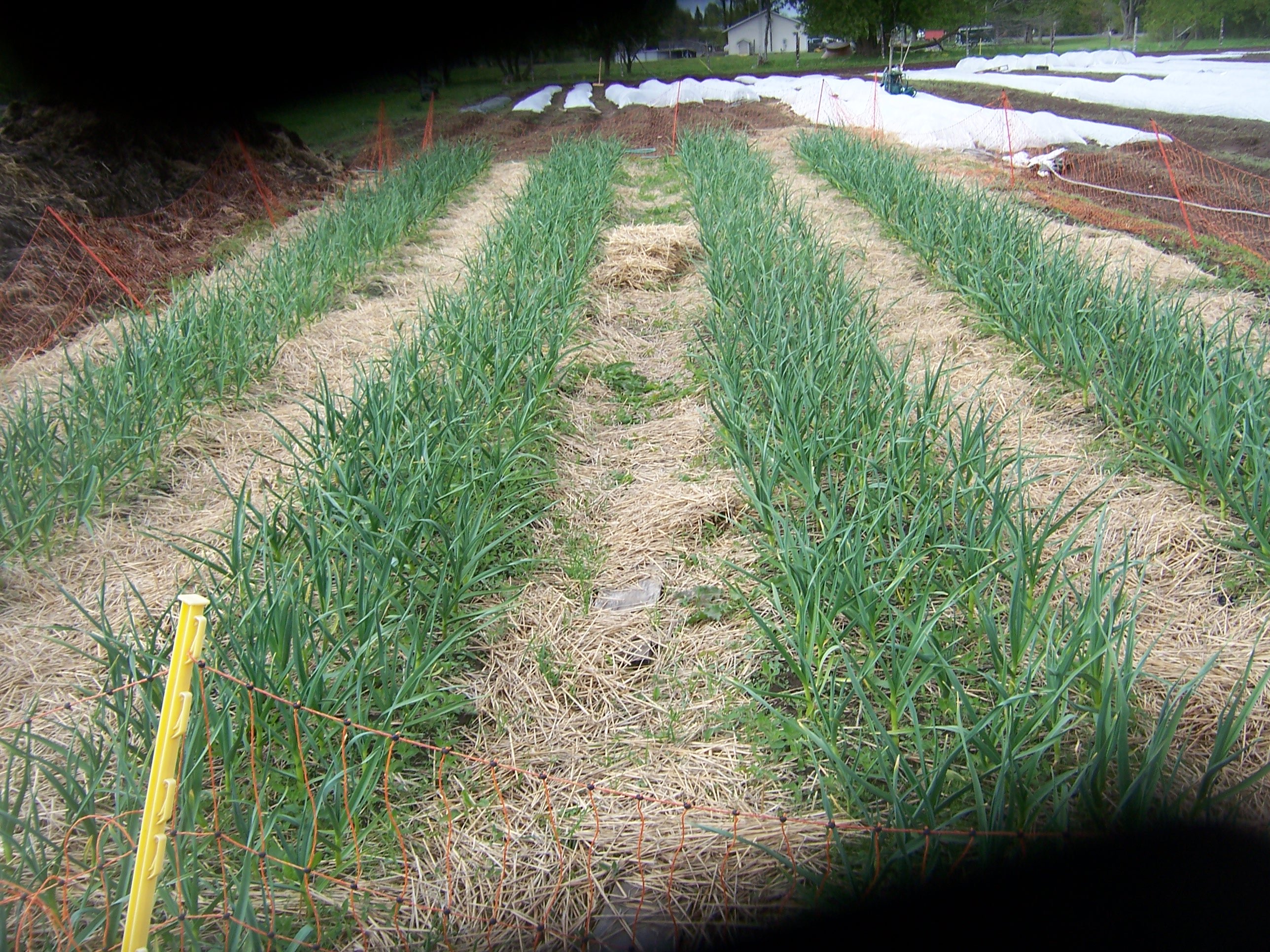 Reuse the winter mulch in the aisles to keep the weeds down Reuse the winter mulch in the aisles to keep the weeds downAfter a good freeze, I cover the garlic beds with a layer of mulch hay, and cover that with a layer of row cover. I remove the mulch in the spring and harvest and cure the garlic mid-July.
I can sell all I grow, at $12/lb. And the best part of this
is, I keep enough of the bulbs so I can re-plant my own garlic again in the
fall. This is pretty much the perfect cash crop for small farm or backyard grower. The variety I grow
most is Music, but check with local growers to find one that works for you. Here's a little more about how I grow garlic. Grow greens right for easy profits
I wouldn’t have said this a couple years ago, but since we started growing mesclun using a soil-less mix in trays, I’m a fan.
This was always a popular crop with customers, and we could sell a 6-ounce bag for $4. But the labour cost of weeding and harvesting when growing in soil made it hardly worthwhile. Now, care is simply making sure the trays are kept adequately watered and fed; I alternately feed organic fish emulsion and liquid kelp. Then it’s clip, rinse, spin and bag. Less fuss, more cash. 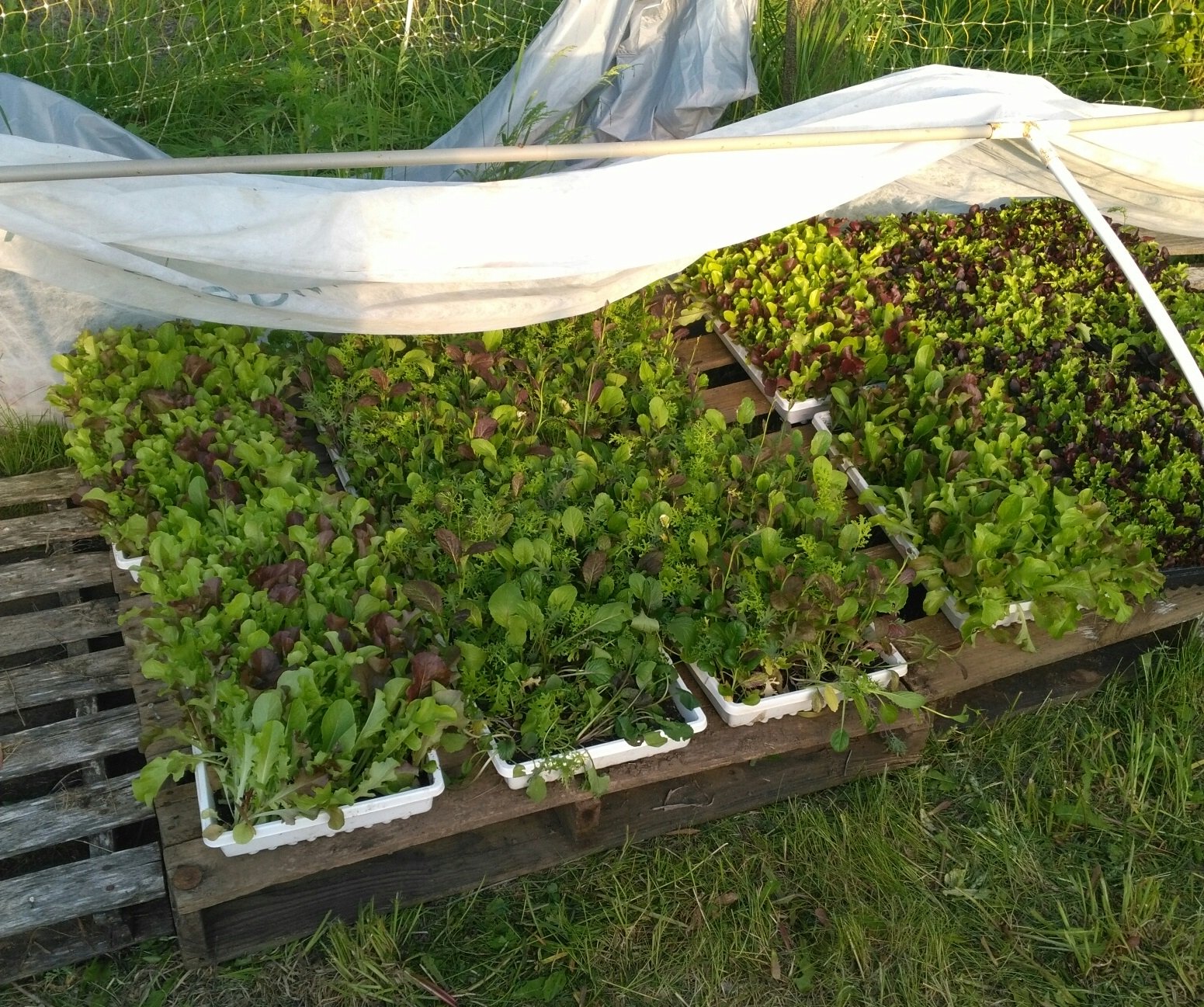 I cover the trays with row cover to keep out the drop-ins I cover the trays with row cover to keep out the drop-insFlowers and herbs are popular at early markets
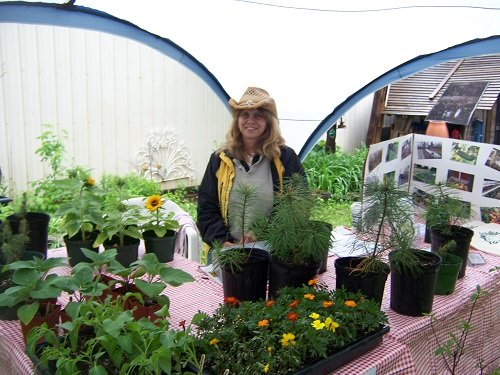 Suzie selling sunflowers Suzie selling sunflowersWe sell an assortment of annuals and culinary herbs in 4
inch pots. The most popular single item continues to be a mini-sunflower from
Johnny Seeds. . We can use the space in
the aisles in our greenhouse to keep the trays of bedding plants for sale. Very little cost or care required, and we sold
the Sunny Smile sunflowers for $6 each, or two for $10.
This is good early-season income; in fact we only plan on 3 or 4 weeks of sales until other crops start coming in. Mini sweet peppers are a sweet seller
Mini ‘lunchbox’ sweet peppers produce very abundantly and the basket of mixed colors was very popular. A basket of peppers like the one shown (it’s a Johnny’s picture, I couldn’t find a good shot from my market stand) sold for $5.
The little plants were very prolific, ripening peppers early and often. I had some old small ‘tomato’ cages that are way too small for tomato plant, but worked very well to keep the peppers upright and easy to pick. 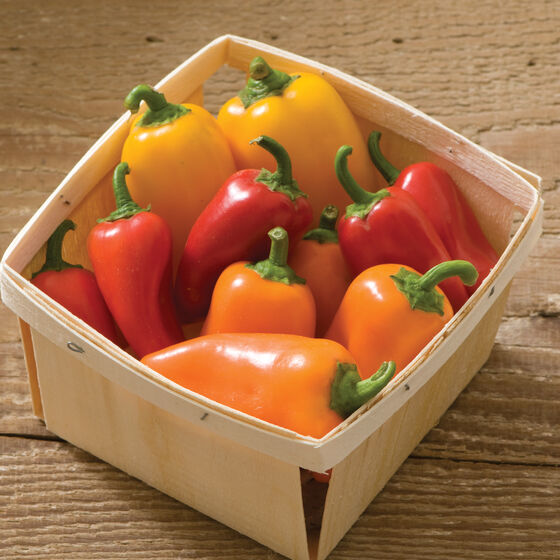 My customers snapped these up My customers snapped these upStrawberries are a high income crop IF you are set up right
Strawberries are not a crop I grow, and it’s probably not for the real small operator or first-time grower. I’m including it on the list of high income crops because it has proven to be very profitable for one of my market buddies. Just Farms in Alexandria grows a LOT of strawberries, and they have gotten very good at it.
Strawberries are usually one of the first crops harvested; Just Farms keeps the harvest going all season by using multiple plantings and several cultivars. They sell very well; I’ve seen my friend Alex Just come to the market with 14 flats of strawbs, and sell out (this is at a market in a village with a population of about 1,500 people). They also sell at several other markets and roadside stands.  Mulch, row cover, and multiple plantings Mulch, row cover, and multiple plantingsHere’s where that evaluation of your environment and your capabilities come in. Just Farms has developed a system over many years, involving multiple varieties, mulch, row cover and overhead irrigation. They also hire about 7 summer-time field workers. It’s is a labour- and management-intensive crop, but if you build a good system you can make a lot of money. The best high income crop is not necessarily the crop with the highest selling price. It is the one we can grow reliably, harvest efficiently and sell consistently in our own market. Start with one or two strong candidates. Test them on a small scale. Track the labour, yield and actual selling price. Then expand the winners, not the crops everybody on the internet says should be profitable. Thinking About Starting a Market Garden?No matter what, people need to eat! The consumer demand for fresh local organic food has never been higher. Bad news on the supply chain is good news for local growers. Get my free Organic Market Gardener Start-up Guide and see if NOW is the right time to launch your CSA market garden business. p.s. Get the Guide and learn how to avoid a beginning market gardener's $5,000 mistake! Keep Planning Your Profitable Garden
|