Raising Chickens for Meat (and Money)
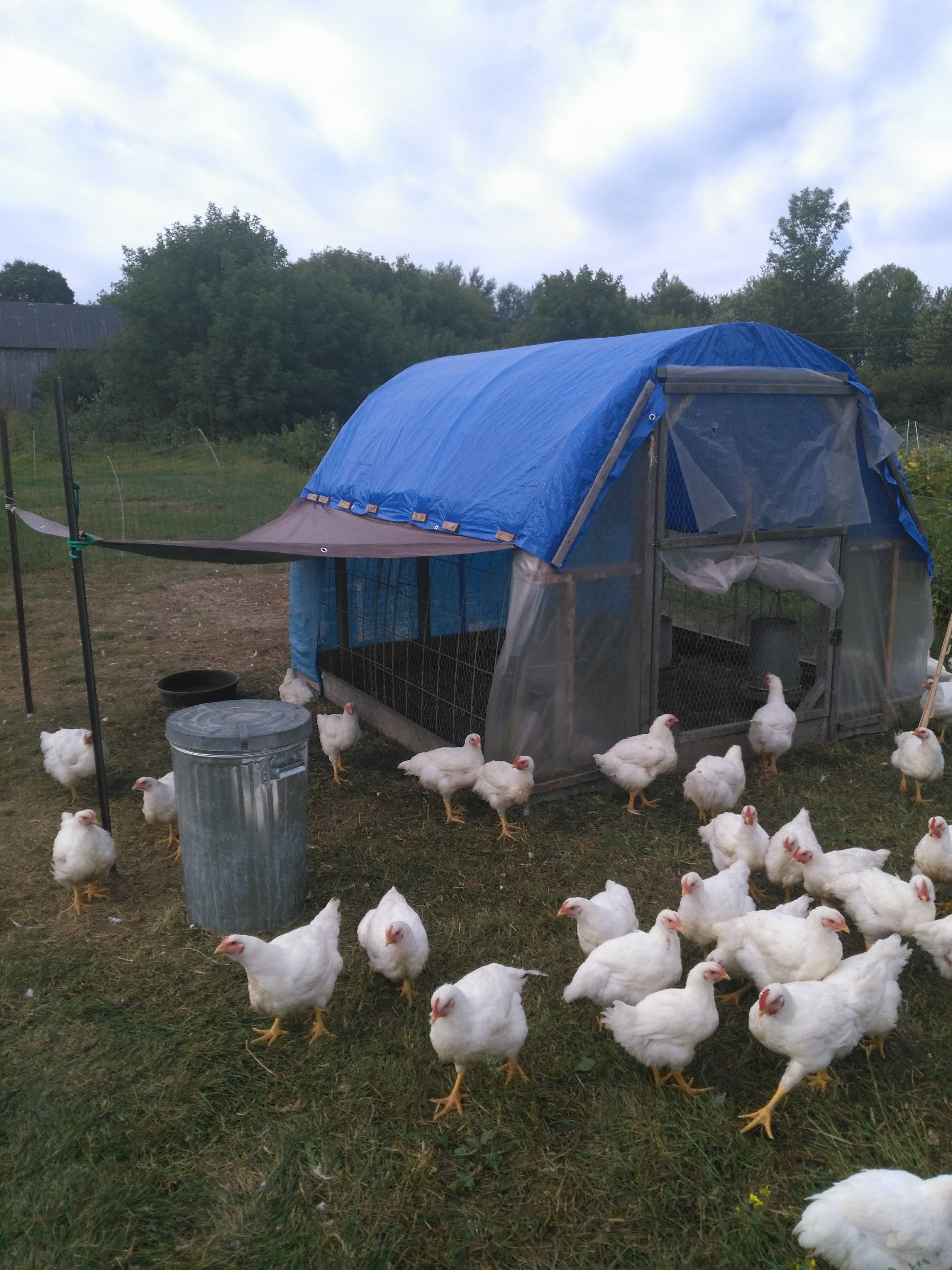 Raising chickens for meat in our day-range coop Raising chickens for meat in our day-range coopRaising chickens for meat can fill the freezer and create a useful seasonal income, but only when we control feed costs, bird losses, equipment and processing. Below, I’ll show you the basic budget formula we use, the equipment you actually need, and where new growers are most likely to lose money. On other pages I've written about feeding chickens, chicken coop ideas, and even lessons from the chicken coop. In this article I want to talk about what kind of money you can expect to make raising meat chickens.
Quick Answer
Can You Make Money Raising Meat Chickens?
Yes—but the birds do not create the profit by themselves. Your margin depends on controlling feed costs, bird losses, processing expenses, and the price customers will actually pay.
Feed Cost
Usually the largest expense and the first place wasted money shows up.
Bird Losses
Poor brooding, predators, and health problems can quickly erase the expected profit.
Dressed Weight
Your income depends on the saleable pounds produced—not simply the number of chicks purchased.
Processing Cost
Book processing early and include the full cost in your selling price.
Selling Price
Calculate your real cost per pound before promising customers a price.
Repeatable System
Reusable equipment and better flock management can make later batches more profitable.
Our practical advice: Start with a manageable flock, use current local prices, and confirm your processing and customers before the chicks arrive.
1
Brooder or Broody Box
The first few weeks are where small mistakes can become expensive.
Chicks need a warm, dry, draft-protected space with enough room to move
toward or away from the heat.
Practical approach: Build a simple broody box sized for
your flock rather than buying an elaborate permanent brooder.
2
Safe Heat Source
Young chicks cannot regulate their body temperature. A securely mounted
heat source helps prevent chilling while allowing chicks to move away
when they become too warm.
Practical approach: Match the heat source to the brooder
size, building material, flock size, and local temperatures.
3
Feeders That Reduce Waste
Feed is usually the largest operating expense. A good feeder keeps birds
from scratching feed onto the ground, standing in it, or contaminating
it with bedding.
Practical approach: Use chick trough feeders during
brooding and raised hanging feeders once the birds move outside.
4
Reliable Poultry Waterers
Meat birds drink a surprising amount of water, especially during warm
weather. Waterers should be stable, easy to clean, and large enough to
prevent birds from running dry between checks.
Practical approach: Use several small waterers for
chicks and larger raised waterers for growing birds.
5
Movable Pasture Coop
A movable coop gives birds shade, nighttime shelter, and regular access
to fresh ground. It also spreads manure rather than concentrating it in
one permanent chicken yard.
Practical approach: Keep the coop lightweight enough to
move regularly, but sturdy enough to provide dependable weather and
predator protection.
6
Electric Poultry Netting
Portable netting keeps day-ranging birds within a manageable paddock and
adds an important layer of protection against many ground predators.
Practical approach: Choose netting that is easy to move
and tall enough to contain the flock comfortably.
7
Fence Energizer
Poultry netting is only as useful as the charge running through it. A
weak or poorly grounded energizer may provide little real protection.
Practical approach: Choose mains, battery, or solar
power based on where the flock will be located and how often it moves.
8
Dry Feed Storage
Damp feed, rodents, and spilled bags quietly eat into the expected
margin. Proper storage protects one of the most expensive inputs in the
entire flock.
Practical approach: Store feed in sealed containers in a
dry, shaded location close enough to make daily feeding convenient.
Start With the System, Not the Shopping List
Equipment does not need to be fancy. It does need to work together.
Before the chicks arrive, make sure you have heat, feed, water, shelter,
fencing, and a practical plan for moving the birds safely onto pasture.
Here's a breakdown of the expenses and income possible. Important: The figures below are an example from our farm records, not current quotations. Feed, chicks, processing and selling prices vary dramatically by location and year. Use the formulas with your own current costs. Here's the formulae: - Total variable cost = Chick cost + feed cost + processing
- Fixed costs = costs for equipment that can be reused and amortized over a number of years
- Cost per pound = (total Variable Cost + Amortized Fixed Costs) / yield in pounds)
- Minimum selling price = Cost per pound + required profit allowance (markup)
Here's some expense figures as an example, substitute your own costs into the formula given to figure your costs. Variable Costs - Day-old chicks @ $1.00 each
- Organic chick starter feed @ $0.30/lb
- Organic chick grower feed @ $0.26/lb
- Processing at abattoir @3.00/each
Fixed Costs
- Broody boxes and heat lamps to shelter the young meat chicks
- Feeders and waterers
- A movable coop
- Electromesh fencing and fence charger
Let's use the information above to make a sample budget for a small meat chicken operation, raising 300 meat birds in 'batches' of 100. We are using small batches so that equipment can be re-used as each batch is finished.
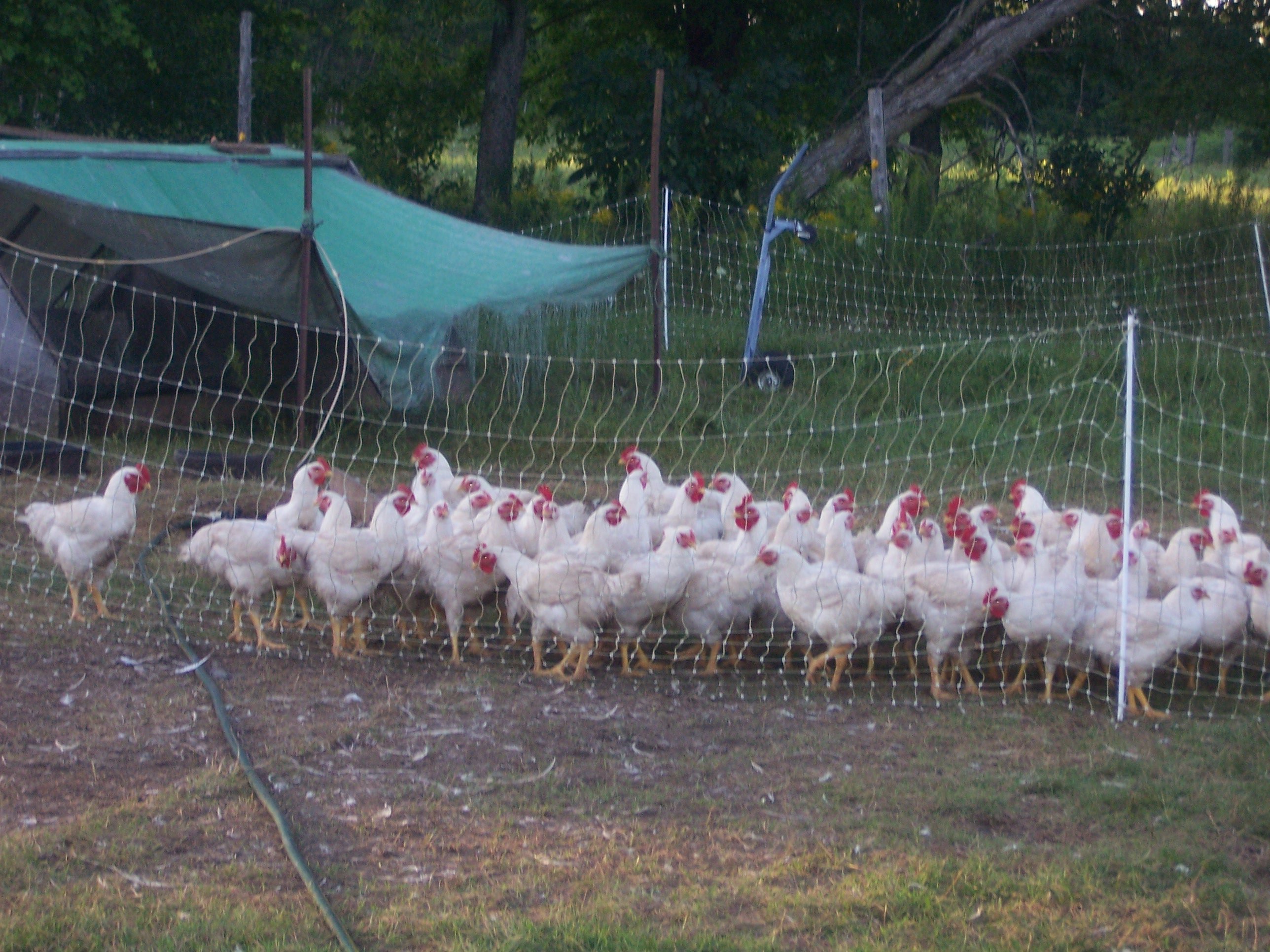 We use movable coops and electric mesh fence to protect our meat birds We use movable coops and electric mesh fence to protect our meat birdsGet The Complete Meat Chicken System
Best for beginners and small-scale growers
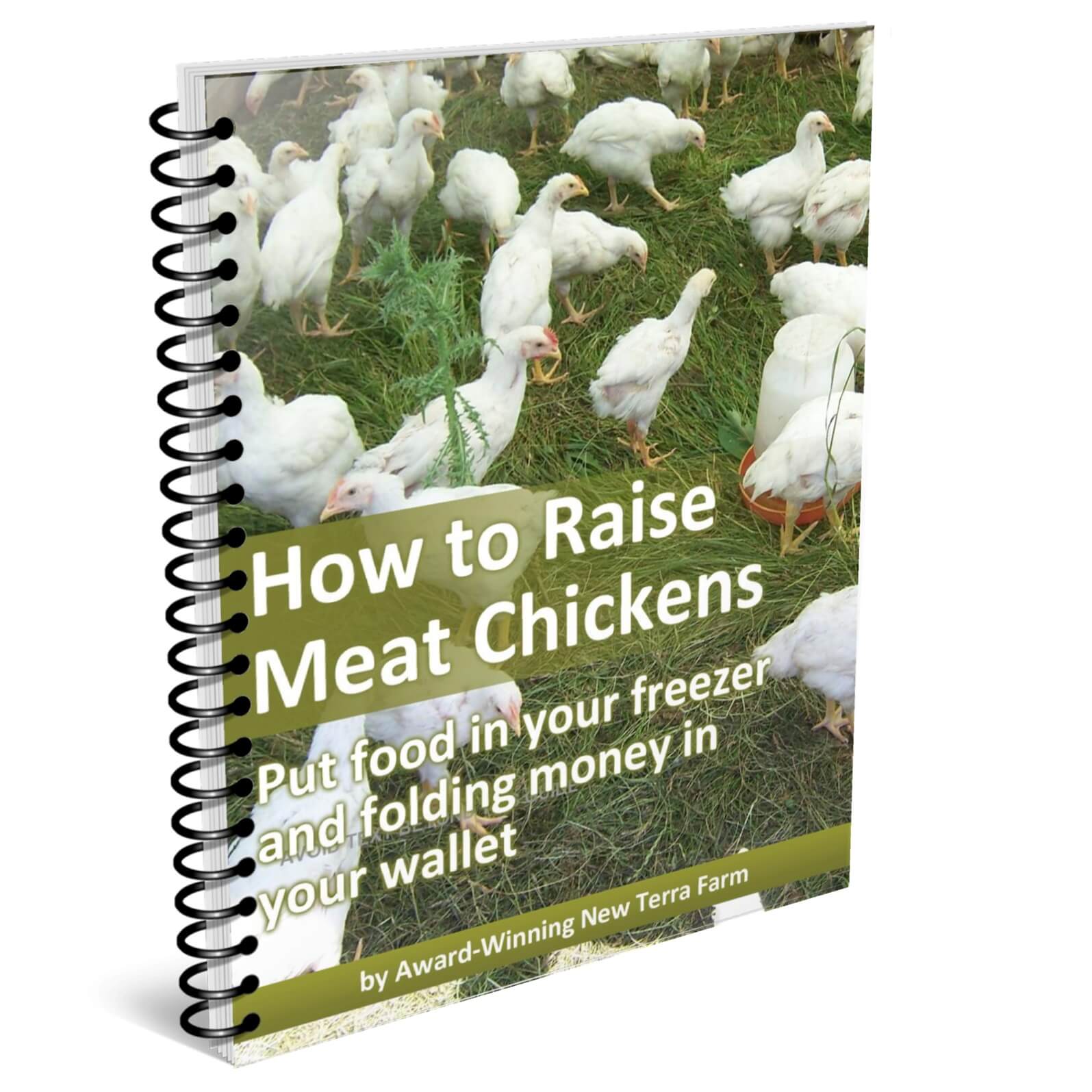
How to Raise Meat Chickens
A practical guide to raising healthy meat birds, avoiding costly mistakes, and building a system that actually works.
If you are thinking about raising chickens for meat, this guide can save you a lot of trial and error. It pulls together what we learned over more than 20 years of raising pastured meat birds.
- Learn how to brood, feed, move, and protect meat birds
- Understand the numbers behind cost, pricing, and profit
- Includes plans for our movable chicken coop and broody box
- Bonus hoop coop plans included
- Built from real farm experience, not theory
Instant download
Farm-tested system
10X guarantee
20+ Years of Small-Farm Experience
·
Practical Poultry Advice
·
Built for Beginners and Small Flocks
·
Focused on Healthy Birds and Real-World Results
Raising Chickens for Meat - Sample Budget
Let's assume we want to raise three batches of 100 meat birds, aiming for a 'market weight' of 5 lbs per bird. Here's how to calculate costs and profits:
Figure a feed conversion of about 5:1 ; that is, it takes 5 lbs. of feed to grow 1 lb. of chicken. This will further break down into 1/3 for organic chick starter feed, and 2/3 for grower. Here's the feed cost using the feed prices given:
300 meat birds x 5lbs. each x feed conversion of 5:1 = a total of 7500 lbs of feed. 1/3 of this is chick starter = 2500 lbs @ $0.30/lb = $750. 2/3 is chick grower = 5000 lbs. x $0.26/lb = $1,300.
So the total feed cost to raise 300 meat chickens is $2,050.
Add in the cost of processing at the abattoir - $3.00 per bird - and the total variable costs = $2,050 + (300 x $3) = $2,950.
Calculating the Fixed Costs. Your fixed costs will vary quite a bit depending on what equipment you use, and if you buy or build your coop, feeders, and broody boxes. I'll use numbers from my records, and you can use the same formula substituting your own figures to calculate your fixed costs. - Movable Coops $150 x3 = $450
- Broody boxes $50 x3= $150
- Lamps, feeders, waterers, etc $175
- Electric poultry netting $150 x3 = $450
- Fence charger, wire, ground posts $250
Total fixed costs: $1475
So, let's run those numbers to create our budget. Assume we can amortize all the equipment over 5 years, and that we will continue to do 3 batches of meat chickens each year. Here's the results:
- Variable cost for 300 birds = $2,950
- Fixed cost for 300 birds (amortized over 5 years) = $1475/5 = $295.
Total costs per batch of 300 meat chickens = $3,245.
Now, what to charge? The cost per pound of your chicken is $3,245 / (300 x 5 lbs.) = $2.16/lb. I recommend a markup of at least 60% or 70%, to allow for losses. So in this example, your price should be around $3.45 - 3.55 lb. This is a markup on cost—not a 60–70% net profit margin. This means you will net around $1,900 on the first 3 batches, which pays for all your equipment and gives you about $500 free and clear.
If you want to see raising chickens for meat on a larger scale, check out my friends Ryan and Monica at Merrifield Farms. They are building a pretty good start-up business from their meat chickens.
Best for Practical Farm Plans
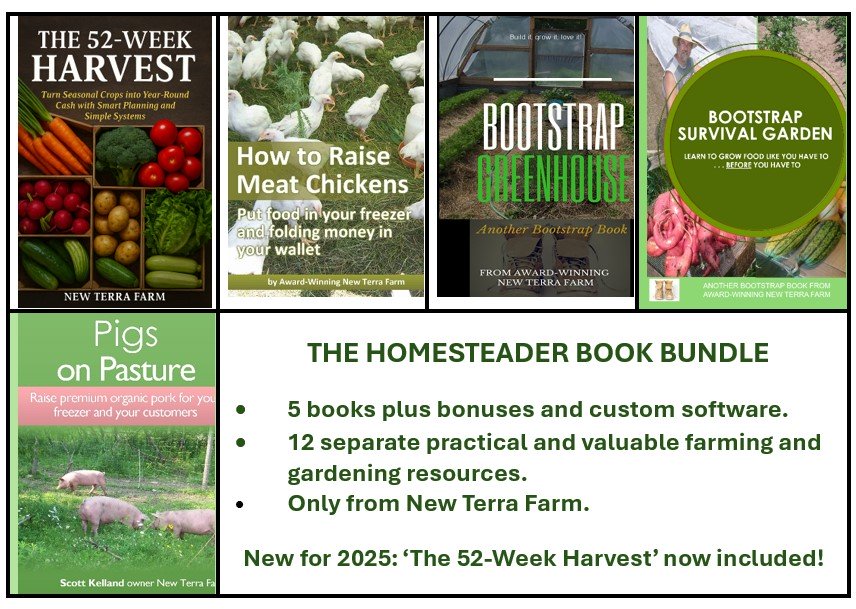
The Homesteader Book Bundle
Raising meat birds is only one part of becoming more self-sufficient.
This collection brings together our practical systems for poultry,
pigs, productive gardens, greenhouses and year-round harvesting.
- Includes How to Raise Meat Chickens
- Chicken-coop and livestock plans
- Garden and greenhouse guidance
- Five books plus seven bonuses
- Based on more than 20 years at New Terra Farm
12 practical resources · $45 value for $27
See the Complete Homesteader Bundle →
Best for Whole-Homestead Projects
The Self-Sufficient Backyard
This substantial guide goes well beyond chickens. It contains more
than 100 illustrated projects covering food production, water,
energy, preservation and other systems for a more independent
backyard or small property.
- Small-space livestock and growing systems
- Food storage and preservation projects
- Water collection and greenhouse ideas
- Solar power and off-grid systems
- More than 250 pages of practical guidance
A broad reference for building the whole homestead
Explore The Self-Sufficient Backyard →
The Self-Sufficient Backyard link is an affiliate link. I may receive a
commission if you purchase through it, at no additional cost to you.
-
Home Page
›
-
Raising Chickens
›
-
Raising Chickens for Meat
|