How to Start a CSA in 72 Hours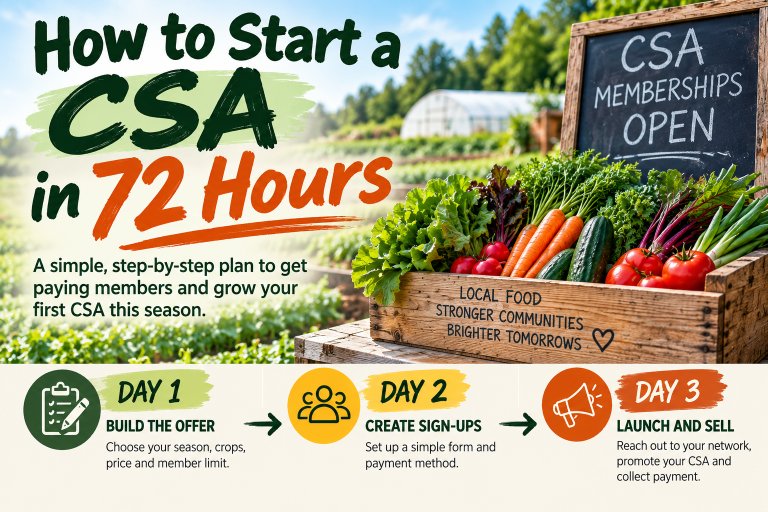 Starting a CSA Doesn't Have to be Complicated Starting a CSA does not need months of planning, expensive software, elaborate websites, and endless churning over what goes into every box. For a small grower, there is a simpler path. Start with a clear offer. Put it in front of real people. Find out whether anyone is willing to pay for it. Then build the production system around proven demand. That is the basic idea behind the How to Start a CSA in 72 hours launch. You are not trying to build the perfect CSA in three days. You are trying to move from “I’m thinking about this” to a real offer with real customers. In the production world this is known as the Minimum Viable Product. How to Start a CSA in 72 Hours Without Overcomplicating ItIf you are wondering how to start a CSA quickly, begin with the business offer, not the planting plan. Before ordering a packet of seed, decide:
For your first attempt, a shorter season can make sense. Twelve weeks is easier to manage than jumping straight into a 20-week commitment, especially if you are still learning what customers want and what you can reliably produce. The key is to keep the first version manageable. Day 1: Build the OfferOne of the biggest mistakes when learning how to start a CSA is offering too much. You don't need 30 different crops. Managing a complex polyculture over a long season is better attempted once you have some experience A simple first-season mix can focus on familiar vegetables such as tomatoes, cucumbers, peppers, lettuce, carrots, kale, beans, zucchini, onions, and herbs. You can see a good example here of productive and profitable crops. Variety for its own sake can come back to bite you, when the season is well under way and you fall behinf on the WWF - Weeding, Watering, Feeding. The goal is to offer your customers dependable value while keeping production realistic. Then establish a starting price. A simple formula is: Weekly box value × season length = seasonal value For example: $30 per week × 12 weeks = $360 You might then decide whether to offer an early-payment discount. We did this for a few seasons to get that early cash flow which helped pay for garden start-up. The exact numbers will depend on your crops, market, and customers. What matters is that you work backward from the weekly value instead of guessing what a share should cost. For a first season, cap membership at a number you can actually serve. Ten customers well fed are a better proposition than 40 members you are not ready for. Our first season we capped production at 10 full shares to learn the business. The next season we more than tripled that, successfully. We built the tool shown below to help us figure out production and share prices. You can get it here. Day 2: Create a Simple Sign-Up SystemWhen you are first figuring out how to start a CSA, sophisticated technology is optional. A basic online form can collect:
Then connect that form to the payment method you already use. Your signup message should answer five questions quickly:
For example: We’re opening 10 places in our 12-week vegetable CSA. Members receive a weekly selection of fresh seasonal vegetables. The season costs $324 paid upfront. Pickup begins in June. Simple and sufficient to start. Don't let software become the project. Day 3: Ask Real People to BuyThis is where how to start a CSA becomes less about planning and more about selling. Start with people who already know you. Contact neighbours, coworkers, friends, previous customers, local food supporters, and people who have already shown interest in what you grow. A simple message might be: I’m launching a small 12-week CSA this season and opening just 10 spots. Would you like me to reserve one for you? This is also a direct test of demand. If you don't get any takers, you may need to adjust your offer or widen your search pool. Starting Smaller is the Safe ApproachA good way to test how to start a CSA is with a pilot. You don't need dozens of members to learn whether the model works for you. A five-member pilot can teach you:
Nothing wrong with book learning, and I encourage research before you leap in. But the practical information from your first season will teach you the things that books don't usually cover (except mine, of course). Get Paid First, Grow SecondOnce you understand how to start a CSA on a small scale, you can add complexity later. You may eventually offer:
But those are second-stage problems. The first hurdle is much simpler: Will local customers commit to the CSA you want to offer? If the answer is 'yes', then you have something worth building on. Your 72-Hour CSA PlanKeep the first launch simple. Day 1: Define the season, crops, price, and member limit. Day 2: Create a straightforward signup and payment process. Day 3: Put the offer in front of real people. You don't need 40 members to prove the idea. You need a handful of customers willing to say: “Yes. Save me a share.” That is the moment your CSA stops being an idea and starts becoming a real business. Ready to Take the Next Step?Once you have your first CSA offer in place, the next challenge is building a farm that can produce reliably, attract customers, and earn its keep. These two resources can help you move from a quick CSA test to a more complete market-garden plan. Free: Small Farm Planning Tools & ChecklistsExplore practical tools for planning crops, customers, farm layout, pricing, startup costs, and other early decisions. See the Free Planning Tools →Build the Farm Behind the CSABootstrap Market Gardening takes you beyond the initial signup test and shows how to build a practical small market garden around profitable crops, real customers, manageable startup costs, and repeatable production. See Bootstrap Market Gardening → |

- Home
- Start a CSA in 72 Hours
